Ranked: Custom Glassware Lamp Shades for Low-Glare Retail and Gallery Lighting
A buyer-side ranking of four Jingxin Glassware lamp shades, scored on glare control, visual comfort, fixture fit, and long-term supply reliability for retail and gallery projects.
Why Glare Control Starts at the Glass Shade
Glare in a retail showroom or gallery is a specification failure that shows up as lost attention. It is rarely caused by the light bulb alone. It is caused by the point at which light leaves the fixture — the glass shade. A 15 cm opal globe and a clear ribbed globe can share the same LED bulb and produce completely different results on a display case.
This article ranks four custom glass lamp shade options that fit low-glare retail and gallery lighting. Each shade is judged against four practical questions that a facilities or procurement team actually asks: does it soften the light before it reaches merchandise, does it look comfortable at visitor eye level, does its fitter opening match the fixtures already installed, and can it be re-ordered consistently across a multi-season program.
The Problem: What Low-Glare Retail and Gallery Lighting Actually Requires
Glare is not a single phenomenon. In retail and gallery spaces it appears in three forms, and each one has a different fix:
- Source glare — the visible brightness of the bulb itself, which forces visitors to look away from the merchandise.
- Reflected glare — the bright spot that bounces off glass display cases, framed artwork, laminated signage, and polished floors.
- Veiling glare — the wash of light that flattens contrast and hides colour and texture, especially on textured or matte products.
A glass shade cannot stop reflected glare coming off a display case. It can, however, control source glare completely and reduce veiling glare substantially — but only if the shade's diffusion mechanism is a body treatment rather than a surface coating.
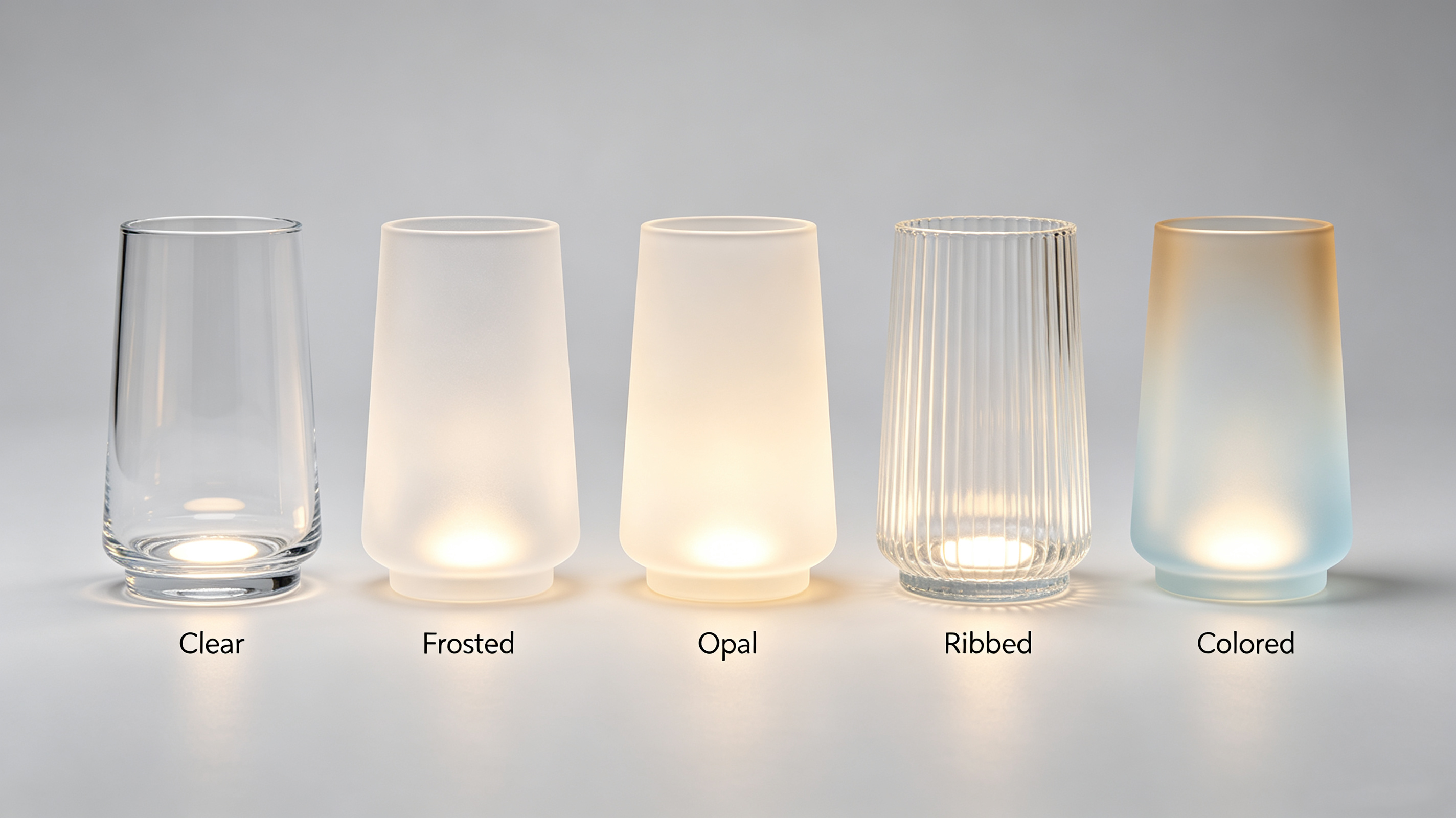
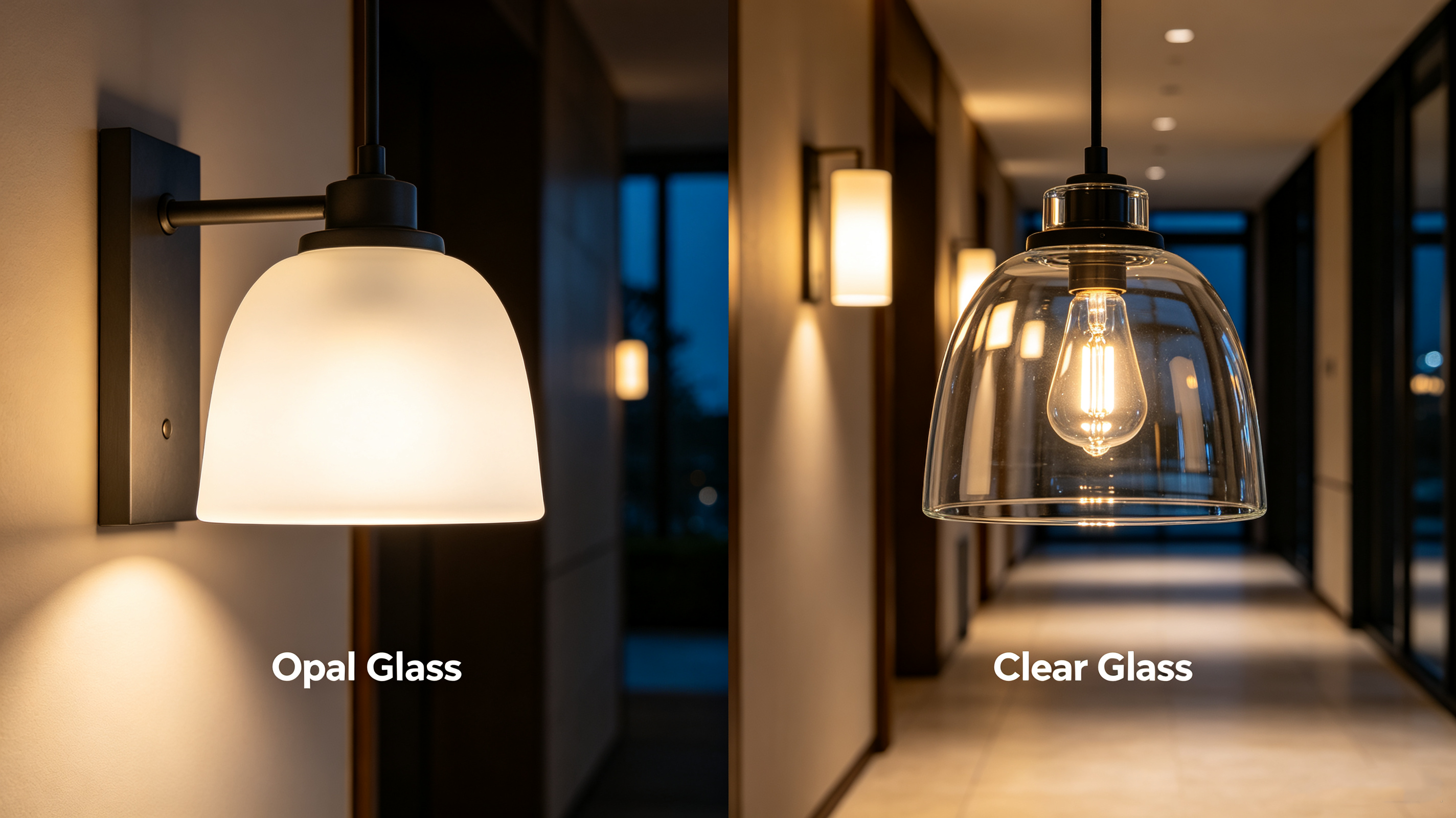
This is where opal glass differs from frosted glass. Frosted glass gets its diffusion from a surface treatment applied after forming, and it can wear, show fingerprints, and lose effect over time. Opal glass carries its diffusion throughout the entire body of the glass, so it never fades, yellows, or degrades — the light source is completely hidden and the whole globe glows uniformly. That distinction is the single most important screening question for a low-glare retail or gallery specification.
Industry Background: How Glass Specifiers Judge Diffusion
Glass shades for commercial lighting are normally compared on light transmission, bulb visibility, price premium over clear glass, and maintenance behaviour. Across the five mainstream finishes, the trade-offs are well documented:
- Clear — 92–95% light transmission, bulb fully visible, baseline price. Maximum brightness, minimal diffusion.
- Frosted — 70–82% transmission, bulb partially hidden, 10–25% premium. Soft glow via surface treatment.
- Opal — 45–65% transmission, bulb completely hidden, 15–30% premium. Even, warm light; body treatment, permanent.
- Ribbed / textured — 85–90% transmission, bulb partially hidden, 20–35% premium. Decorative refraction and pattern projection.
- Coloured — 20–85% transmission depending on colour, 20–50%+ premium. Design statements and branded environments.
For retail and gallery work, the practical consequence is that a low transmission figure is not a weakness. It is the whole point. A shade that passes 45–65% of light and scatters it across the whole surface eliminates hot spots and produces comfortable ambient illumination, which is exactly what protects the viewing experience in a showroom or exhibition room.
Ranking Criteria Used in This Guide
Each shade below is ranked on the same four criteria, weighted for retail and gallery use:
- Glare control and diffusion quality — how completely the bulb is hidden and how evenly light spreads.
- Visual comfort and light character — the colour temperature feel and whether the shade looks comfortable at visitor eye level.
- Fit and fixture compatibility — fitter opening size, diameter, and whether the shade matches standard E27, E14, or G9 holders.
- Thermal safety and long-term supply reliability — glass type, heat behaviour, and whether the item can be repeated across seasons with consistent quality.
All four products below are manufactured by Jingxin Glassware, a custom glassware manufacturer based in Yancheng, Jiangsu Province, founded in 1999 and exporting to 100+ countries. The company runs production lines for both soda-lime and borosilicate glass, applies quality control from raw material to finished goods, and performs 100% pre-shipment inspection with third-party testing available on request.
Ranked: Four Custom Glass Lamp Shades for Low-Glare Retail and Gallery Lighting
1. Opal White Glass Globe Lamp Shade (JX1004) — Best Overall for Glare Elimination
The JX1004 is a hand-blown opal white glass globe with a frosted matte finish. Its defining property is that the opacity is uniform throughout the entire glass body rather than applied to the surface, so the light source is completely hidden and the diffusion never wears, fades, or yellows.
Why it ranks first: opal glass diffuses light evenly at 45–65% transmission, which creates soft, glare-free ambient illumination that is gentle on the eyes. For a gallery where visitors look up and sideways at objects for long periods, that is the difference between comfortable viewing and squinting. The 60 mm fitter opening accommodates standard E27 lamp holders, so it drops into the pendants, wall lamps, and ceiling fixtures most retail fit-outs already use.
Specification at a glance: diameter 150 mm, fitter opening 60 mm (E27), wall thickness 3.0–5.0 mm, solid opal white soda-lime glass, 100% lead-free and recyclable, heat resistance up to 120°C.
Long-term supply note: because the milky-white colour is a body property rather than a coating, batch-to-batch colour consistency is easier to hold across repeat orders — an important point when a chain refits additional stores over several seasons. Jingxin has already delivered opal white glass globe shades for a permanent wall installation at Galeries Lafayette in Paris, a project that required consistent colour uniformity and precise dimensional accuracy across all units.
2. Double Wall Glass G9 Light Globe (JX1416) — Best for High-Heat and Compact Fixtures
The JX1416 is a hand-blown borosilicate globe with a clear outer layer and a frosted inner layer, fitted to a standard G9 thread. The double-wall construction is the key feature for retail environments where small decorative fixtures run warm or where the same shade must survive temperature swings.
Why it ranks second: borosilicate glass has a far lower coefficient of thermal expansion than soda-lime, so it tolerates sharp temperature changes — the specification on this model is thermal shock resistance up to 550°C. In a retail space, that matters when a fixture is switched on in a cold, air-conditioned room, or when a display is cycling on and off all day. The inner frosted layer softens the bulb while the clear outer layer keeps the globe looking clean and contemporary, so glare control comes without a heavy, milky appearance.
Specification at a glance: diameter 100 mm, G9 thread fitter, wall thickness 1.5–2.0 mm, borosilicate glass, 45–65% light transmission with uniform diffusion, 100% lead-free and recyclable.
Where it fits: boutique pendants, compact wall sconces, and display fixtures where the shade diameter is small but the bulb load is high. It is also the safer default when a mid-project change replaces LED with a higher-output lamp.
3. Clear Ribbed Glass Pendant Shade (JXHB-002) — Best for Decorative Feature Lighting
The JXHB-002 is a crystal-clear soda-lime globe with uniform vertical fluted ribbing across the outer surface. When lit, the ribs refract light into striped patterns, which is a strong design feature in café interiors, concept stores, and gallery entrance zones.
Why it ranks third: the ribbed surface delivers extremely high transmission at 85–95%, so it is the brightest shade in this set — which makes it a poor choice directly over light-sensitive artwork or glass display cases. It earns its place in the ranking because ribbed glass partially hides the bulb and breaks up the direct beam, so it produces a decorative, textured glow rather than a hard point source. Used on a dimmed circuit in a circulation zone, aisle, or reception area, it adds character without creating source glare over the merchandise itself.
Specification at a glance: diameter 200 mm, fitter opening 100 mm, wall thickness 3±1 mm, clear soda-lime glass, hand-blown, temperature tolerance up to 120°C, 100% lead-free and recyclable.
Supply note: the rib depth and opening size are customisable, so a retailer can align the refraction pattern with a brand's fixture family while keeping the same core globe across a rollout.
4. Glass Globe Lamp Shade (JX1188) — Best Decorative Accent for Boutique Retail
The JX1188 is a hand-blown soda-lime globe with warm amber-brown marble swirl patterns flowing over a milky opal base. Every piece has one-of-a-kind natural streaks, so no two globes are identical.
Why it ranks fourth: the opal base softens harsh bulb light and spreads a warm, gentle glow while keeping glare low, which makes it a good fit for boutique retail, café, and hospitality interiors. It sits at number four rather than higher because the marbled pattern is a decorative statement, and a retail or gallery program that needs visual uniformity across dozens of identical units will usually prefer the plain opal globe of the JX1004. Where differentiation matters more than uniformity — a single flagship entrance, a bar counter, a hotel lobby vignette — the swirl pattern adds value that the plain globe cannot.
Specification at a glance: diameter 100 mm, top opening 20 mm, wall thickness 3 mm, soda-lime glass, opaque milky base with amber swirl, compatible with pendant, ceiling, and wall fixtures.
Step-by-Step: How to Specify a Low-Glare Glass Shade Program
Ranking shades is the easy part. Getting the specification right across a multi-store or multi-exhibition program is where most projects lose time. The following sequence reflects the workflow Jingxin recommends to custom lighting buyers.
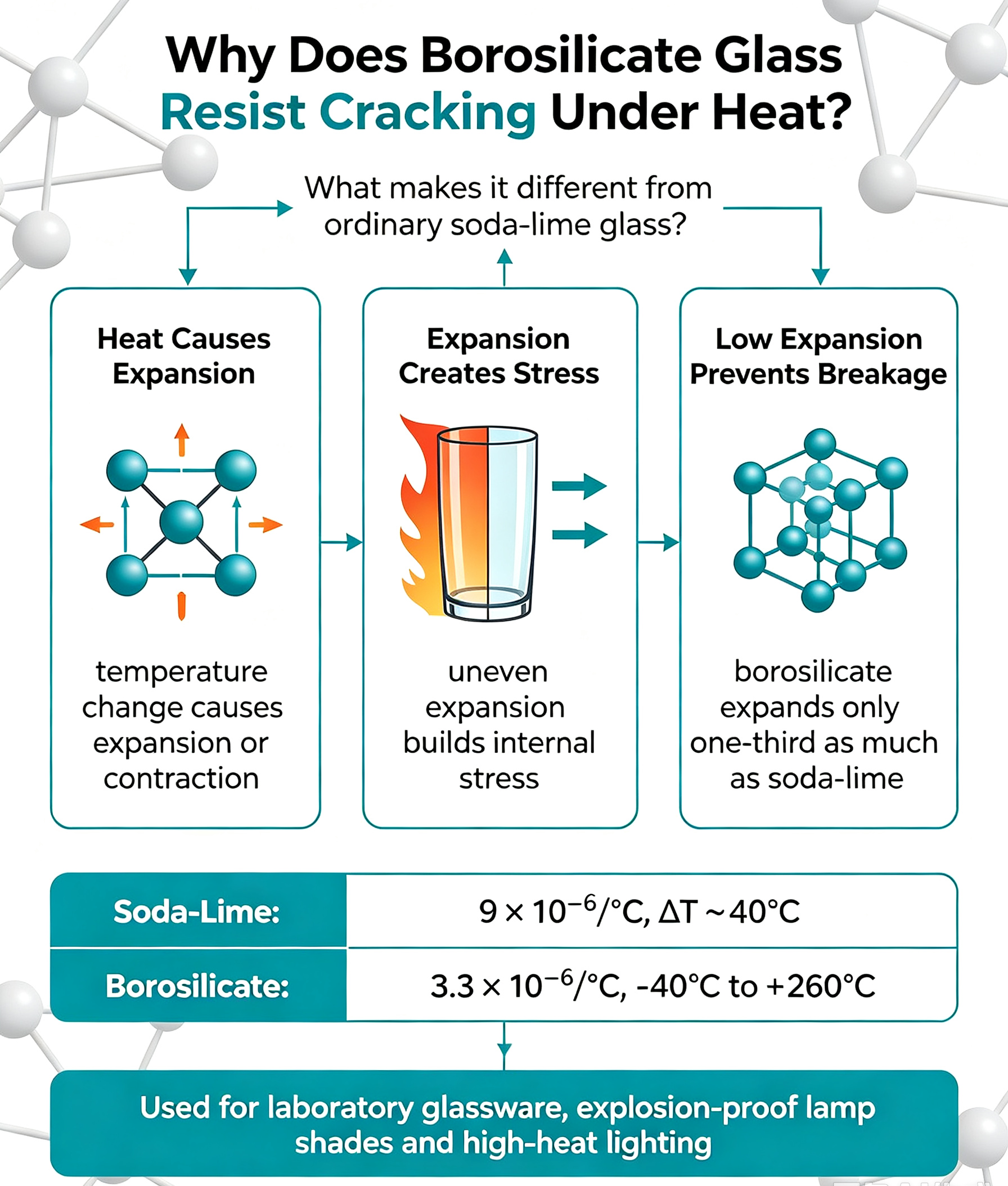
Step 1 — Confirm the fixture temperature before choosing the glass type. Soda-lime glass has a temperature rating of 120°C; borosilicate glass has a rating of 300°C and tolerates rapid temperature change. If a fixture runs warm, or the space has strong temperature swings, borosilicate is the recommended material. If the fixture is a standard low-heat LED pendant, soda-lime opal glass delivers the best glare control per unit of cost.
Step 2 — Measure the fitter opening, not the shade diameter. The most common ordering error is a mismatch between the shade opening and the lamp holder. The JX1004 uses a 60 mm opening for E27 holders, the JX1416 uses a G9 thread, the JXHB-002 uses a 100 mm opening, and the JX1188 uses a 20 mm top opening. Verify the fitter opening size with the supplier before mass production and request a sample for approval to confirm dimensional accuracy and fit.
Step 3 — Choose the diffusion level against the merchandise, not the room. Opal shades belong directly over and around the products or artworks. Ribbed shades belong in circulation zones, entrances, and accent positions where decorative refraction is desirable. Do not put a high-transmission ribbed globe directly over a glass display case.
Step 4 — Set the order quantities and MOQ. The minimum order quantity is 500 pieces for hand-made glass and 2,000 pieces for machine-made glass on select stock items, with custom MOQ negotiable for smaller trial orders or pilot installations.
Step 5 — Approve a production sample before committing the rollout. Sample lead time is 5–7 days after artwork and specification confirmation. Mass production lead time is 20–30 days after sample approval.
Step 6 — Agree packing, inspection, and long-term supply terms in writing. Confirm all specifications in writing before production. For long-term supply arrangements, agree replacement and claim handling for damaged glass products in advance so that repeat orders and annual contracts run without renegotiation.
Use Cases: Matching the Shade to the Space
Art galleries and exhibition rooms. The JX1004 opal globe is the strongest match where visitors spend time in front of objects. Its complete bulb hiding and even distribution reduce veiling glare on framed work and keep the ambient level comfortable.
Jewellery and premium retail counters. Low-transmission opal diffusion prevents the bright spot that appears when a clear globe reflects off a glass counter. Where the counter has its own task lighting, the shade's job is to control the ambient layer without competing with it.
Concept stores and cafés. The JXHB-002 ribbed pendant delivers the decorative refraction that concept interiors want, while the JX1188 marble swirl globe adds a warmer, artisan character to bar counters and boutique seating areas.
Compact high-heat display fixtures. The JX1416 borosilicate double-wall globe handles small diameter fixtures and higher bulb loads, and is the recommended option when a project switches to a warmer, higher-output lamp partway through specification.
Multi-site rollouts. A chain that refits stores in sequence needs the same shade, the same colour, and the same fit, order after order. Opal body colour and plain globe shapes are the easiest items to keep consistent across repeat orders.
Comparison Table
| Rank | Product | Glare Control | Fit & Size | Glass Type |
|---|---|---|---|---|
| 1 | Opal White Glass Globe Lamp Shade (JX1004) | Opal body diffusion, 45–65% transmission, bulb completely hidden | D150 mm, 60 mm opening for E27 | Solid opal white soda-lime, up to 120°C |
| 2 | Double Wall Glass G9 Light Globe (JX1416) | Double wall, clear outer + frosted inner, 45–65% diffusion | D100 mm, G9 thread | Borosilicate, thermal shock up to 550°C |
| 3 | Clear Ribbed Glass Pendant Shade (JXHB-002) | Ribbed refraction, 85–95% transmittance, bulb partially hidden | D200 mm, 100 mm opening | Clear soda-lime, up to 120°C |
| 4 | Glass Globe Lamp Shade (JX1188) | Opal base with marble swirl, soft diffused light, low glare | D100 mm, 20 mm top opening | Soda-lime, 3 mm wall |
Parameters as published for each Jingxin Glassware model. Opal glass carries a 15–30% price premium over clear glass; ribbed adds 20–35% over clear. Diffusion figures refer to light transmission.
Risk and Maintenance Knowledge Every Buyer Should Apply
Choosing the right shade is half the job. The other half is avoiding the failure modes that show up six months after installation.
Thermal shock. Thermal shock occurs when different parts of a glass object expand at different rates because of a temperature difference. When the internal stress exceeds the material's strength, the glass cracks. Soda-lime glass tolerates differences up to roughly 40°C and should not be used above 120°C; borosilicate glass tolerates far sharper changes. If a fixture runs hot or the space cycles temperature, specify borosilicate rather than assume the shade will manage.
Annealing and internal stress. Proper annealing during production is critical to remove internal stress and prevent spontaneous breakage. This is a supplier quality-control question, not something the buyer can inspect visually. Require in-process control and 100% pre-shipment inspection, and use third-party testing on high-value orders.
Installation risk. Before installation, inspect the glass for cracks or chips and do not install damaged shades. Switch the fixture off and let it cool. Verify the fitter opening matches the holder (E27, E14, or G9), slide the shade onto the holder, secure it with the mounting ring, screws, or locking mechanism, confirm firm seating, reinstall the bulb, then switch on and check alignment. Never force a shade onto a holder — a forced fit is a cracked shade waiting to happen.
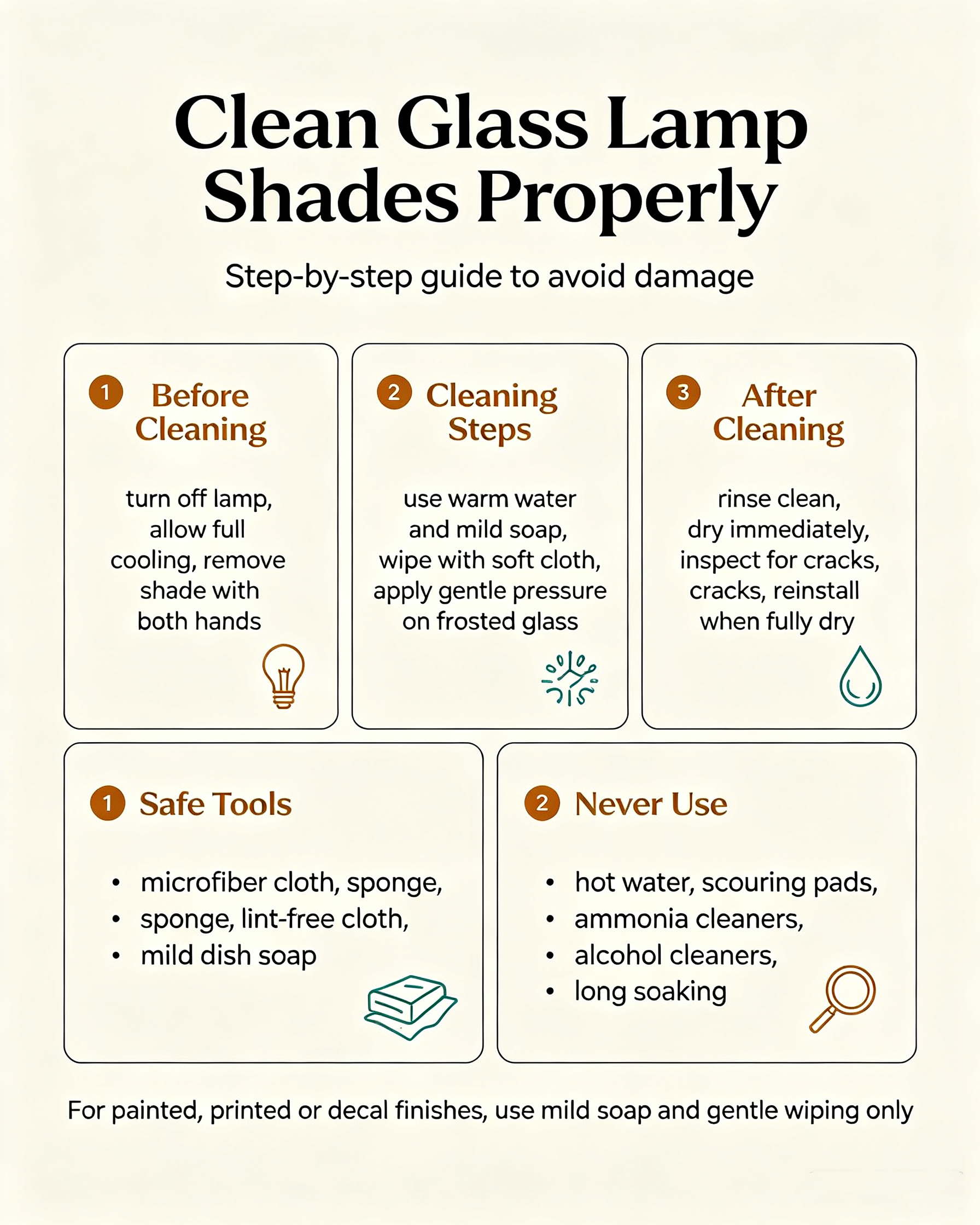
Cleaning without damage. Turn the fixture off and let the shade cool to room temperature, then remove it with both hands. Clean with warm water and mild dish soap using a soft microfiber cloth. Avoid abrasive or alcohol-based cleaners, and never immerse the shade in hot water, because the thermal shock can crack it. For frosted or opal surfaces, use gentle pressure only, and dry immediately with a lint-free cloth to prevent water spots.
Transit breakage. Glass damage in transit usually traces back to packaging design rather than handling alone. Multi-layer protection, correct separation, and palletised loading with strapping reduce risk substantially. Buyers can request enhanced packaging — additional foam, thicker dividers, or custom inserts — and can require pre-shipment photos of packaged goods before dispatch. For high-value shipments, SGS third-party loading supervision is available. If damage does occur, inspect on arrival, document with photos, and contact the supplier promptly; replacement or credit for breakage is handled under warranty terms.
Surface finish durability. Uneven etching, poor adhesion of silk-screen printing, and peeling of spray paint are almost always process-control problems rather than material problems. Jingxin runs in-house surface finishing including acid pickling, sandblasting, silk-screen printing, stamping, decalcomania, and spray painting, and inspects finish quality at each stage. Where a brand logo or colour is applied to a shade, request samples before bulk orders to confirm finish quality and durability.
Frequently Asked Questions
What certifications should a retail or gallery project verify before ordering custom glass lamp shades from a Chinese manufacturer?
Buyers sourcing glass lamp shades from China should prioritize suppliers holding CE, RoHS, REACH, ISO 9001, and SMETA-4P. CE is mandatory for lighting products exported to the European Union; RoHS restricts hazardous substances; REACH requires compliance with SVHC restrictions for products sold in the EU; ISO 9001 confirms a documented quality management system; SMETA-4P covers labour standards, health and safety, environment, and business ethics, and is commonly required by EU and US retailers for supply chain compliance. Jingxin Glassware holds 19+ professional certifications, including a RoHS test report issued by Intertek (No. 251016112GZU-001) and SMETA-4P certification from TUV Rheinland (No. ZAA600149732), with documentation available on request. Buyers should always request copies and check expiry dates.
Can a Chinese custom glassware manufacturer keep opal glass shades consistent across an annual lighting supply program?
Consistency is achievable when the opacity comes from the glass body rather than a surface coating. In opal glass, opacifying agents are mixed into the glass batch, so the diffusion is uniform throughout the entire thickness and is permanent — it does not fade, yellow, or degrade. That is why chain retailers and multi-site rollouts tend to standardise on opal globes rather than frosted ones, where diffusion is limited to the surface layer. Jingxin Glassware operates a 4,500 m² production base with more than 100 staff and an R&D team of 5 engineers, maintains production lines for both soda-lime and borosilicate glass, and reaches an annual capacity of 25,000,000 sets, which supports repeat and long-term supply requirements.
What is the minimum order quantity and cost structure for custom glass lamp shades?
The MOQ is 500 pieces for hand-made glass and 2,000 pieces for machine-made glass on select stock items, with custom MOQ negotiable for smaller trial orders. On cost, opal glass typically carries a 15–30% premium over clear glass, frosted finishes add 10–25%, and ribbed or textured finishes add 20–35%, because of the additional processing involved. A retail project that mixes opal globes over merchandise with ribbed pendants in circulation zones therefore pays two different premiums for two different jobs, which is usually more cost-effective than applying the same shade everywhere.
Can buyers request samples before committing to a long-term supply contract?
Yes. Samples are available on request; sample cost may apply and freight is collect. Sample lead time is 5–7 days after artwork and specification confirmation. Jingxin recommends confirming all specifications in writing before production and approving a pre-production sample to verify dimensional accuracy and fit, particularly for fitter openings. Requesting a sample is the single most effective way to avoid the most common ordering error — a shade that does not seat correctly on the lamp holder.
What are the typical lead times for an annual lighting supply program?
Sample lead time is 5–7 days after specification confirmation, and mass production lead time is 20–30 days after sample approval for the shades in this ranking. For large-volume or complex custom projects, timelines may vary and should be confirmed at quotation stage. International logistics cover sea, air, rail, truck, and courier with routing tailored to each order, and the export team handles documentation including customs clearance, shipping marks, FORM E, and CO. For long-term supply, agree replacement and claim handling for damaged glass in advance so repeat orders and annual contracts proceed without delay. To review the full lamp shade range and request a sample or quotation, download the Jingxin Glass Lamp Shades Catalogue or contact the team directly at jerry@cn-glassware.com.
Conclusion
Low-glare retail and gallery lighting is a diffusion problem before it is a fixture problem. Of the four shades ranked here, the Opal White Glass Globe Lamp Shade (JX1004) is the strongest default — its body-treatment opacity hides the bulb completely, spreads 45–65% of light evenly, fits standard E27 holders, and holds its colour across repeat orders. The Double Wall Glass G9 Light Globe (JX1416) is the right answer when the fixture is compact or runs hot, thanks to borosilicate construction and up to 550°C thermal shock resistance. The Clear Ribbed Glass Pendant Shade (JXHB-002) earns its place in circulation zones and entrances where decorative refraction is wanted and direct illumination over merchandise is not. The Glass Globe Lamp Shade (JX1188) suits boutique accents where an artisan marble swirl is worth more than visual uniformity.
For buyers building a multi-season lighting program, the practical decision is not which shade is best in isolation, but which combination of shades can be repeated reliably. That means confirming fitter openings in writing, approving a production sample, setting MOQ and lead times against the store opening schedule, and agreeing replacement terms for the life of the contract. Jingxin Glassware's position as a long-term custom glassware supplier — 100+ export markets, 1,000+ global clients, 100% pre-shipment inspection, and 19+ professional certifications — is built for exactly that kind of repeat demand.
Next step: send your fitter opening measurements, target quantity, and glass type preference to Jingxin Glassware for a sample and quotation, or download the Glass Lamp Shades Catalogue to review the full range.
Yancheng Jingxin Glassware Co., Ltd. · No.268 South Jiefang Road, Yancheng, Jiangsu, China · Tel: +86 515-8822 9059 · WhatsApp: +86 18019627905 · Email: jerry@cn-glassware.com · www.cn-glassware.com · blog.cn-glassware.com
Have Questions or Need More Details?
Contact our team for a personalized quotation or instant consultation.
Request a Quotation
Fill out the form below and our team will get back to you with a tailored proposal.
WhatsApp Direct Chat
Prefer to chat in real-time? Message us on WhatsApp for instant assistance & quick answers.
- Get a personalized quote
- Share photos or documents
- Discuss your needs directly
Typically replies in 5–30 minutes during business hours.