
How to Evaluate a Custom Glass Lamp Shade Supplier
Evaluate a custom glass lamp shade supplier by verifying six things before the purchase order is signed: the glass grade and its thermal limit, the light-diffusion method, the fitter and thread dimensions, the tested thermal shock range, the packaging specification, and the written acceptance criteria. A supplier who can quote a shade is not automatically a supplier who can deliver it at tolerance.
Custom glass lamp shades are bought as lighting components but judged as visual products. The buyer's risk is not that the supplier cannot make a shade. The risk is that the shade that arrives is not the shade that was approved - a different glass, a looser thread, a warmer opal, or a carton that no longer protects the glass. This guide sets out the checks that separate a quote from a delivery, using published product data from Jingxin Glassware as the reference case.
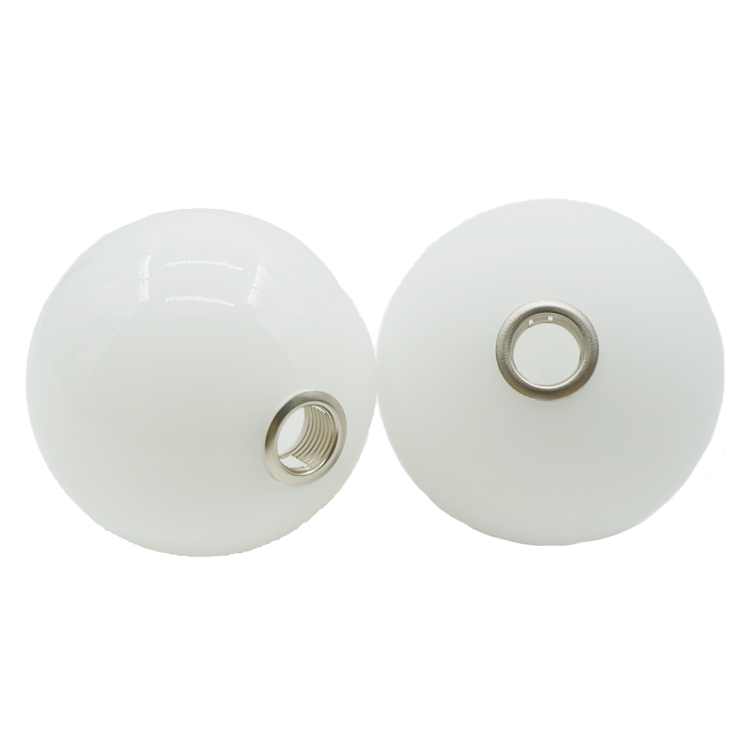
Cover: Blown Glass Lampshade with G9 Thread (JX1184), an opal white soda-lime globe with a built-in G9 metal internal thread insert. Image: Jingxin Glassware.
Problem Definition: Why Capability and Delivery Assurance Are Different Questions
The failure pattern in custom glass lamp shade sourcing is consistent. A buyer receives samples that fit the lamp holder and look correct. Mass production arrives weeks later with a thread insert that sits slightly off nominal, an opal batch that reads warmer than the approved sample, and a carton that was downgraded from five-layer to three-layer at the factory. The buyer is now holding a shipment that is technically within the scope of 'glass lamp shade' but commercially out of specification.
These failures are rarely caused by a supplier who cannot blow glass. They are caused by capability being asserted at the quotation stage instead of verified at the specification stage. Quoting a shade requires a price. Delivering a shade requires a controlled glass composition, a controlled thread insert, a controlled thermal profile, a controlled finish, and a controlled packing line. Those five controls are what a buyer is actually evaluating.
Delivery assurance is therefore a separate question from capability. Capability asks whether the supplier can make the part. Delivery assurance asks whether the supplier can repeat it across the production run, across the inspection lot, and across the freight journey. A supplier evaluation that only tests the sample answers the first question and ignores the second.
Industry Background: What Makes Glass Lamp Shades Harder to Verify Than Decorative Glass
A glass lamp shade is a functional lighting component with a decorative surface. It has to fit a lamp holder, survive the heat of the light source, deliver the specified light distribution, and survive the shipping environment. That combination makes verification harder than for a purely decorative glass item, because the same shade is simultaneously judged on dimensional accuracy, optical consistency, thermal behaviour, and mechanical condition on arrival.
The material choice is the first source of divergence. Soda-lime glass and borosilicate glass behave differently under heat, and the difference is not cosmetic. Jingxin's published product data shows the gap clearly. The JX1184 Blown Glass Lampshade with G9 Thread is made of solid opal white soda-lime glass and tolerates temperature fluctuations up to 120 degrees Celsius. The JX1416 Double Wall Glass G9 Light Globe uses borosilicate glass and tolerates sharp temperature changes up to 550 degrees Celsius. The JX1830 Explosion-Proof Borosilicate Glass Lamp Shade is rated from -40 degrees Celsius to 260 degrees Celsius.
The second source of divergence is the fitter. G9 and E27 are lamp holder families, not single dimensions. Within the same supplier, the JX1184 uses a built-in G9 metal internal thread insert with a 20 mm opening and a 2.5 to 3.5 mm wall thickness. The JX1416 uses a G9 thread with a 22 mm threaded opening and a 1.5 to 2 mm wall thickness. The JX1407 Borosilicate Glass Globe Lamp Shade uses an E27 fitter with a 4.5 cm opening and a 2 mm wall thickness. Each is a valid G9 or E27 product, and each will behave differently on the same fixture.
The third source of divergence is the meaning of the word 'opal'. In opal glass, opacifying agents are mixed through the glass batch, so light diffusion is uniform through the full thickness of the glass and does not wear away. In surface-frosted glass, diffusion is a surface treatment. Both can look similar in a single sample and behave differently after a year of cleaning.
The Six Capability Checks That Separate Quoters from Deliverers
1. Confirm the Glass Grade, Not the Phrase 'Heat Resistant'
Ask the supplier to name the glass body and its tested temperature range. An answer of 'heat resistant glass' without a grade, a range, or a test basis is not an answer. For a decorative LED fixture, soda-lime glass with a 120 degrees Celsius rating may be adequate, provided the bulb and driver keep the shade inside that limit. For a high-heat fixture or a fixture with poor ventilation, specify borosilicate. The JX1416 and JX1830 both use borosilicate glass, and both are published with a specific thermal range rather than a generic claim.
The practical check is to request the material declaration and the thermal rating in writing, then compare it with the fixture's measured shade temperature. If the supplier cannot supply either document, the design margin is unknown.
2. Confirm Whether Light Diffusion Is Through-Body or Surface-Only
Request two samples from the same batch and compare them under the same lamp. Look for colour shift, visible hot spots, and differences in diffusion between the two pieces. For opal products such as the JX1004 Opal White Glass Globe Lamp Shade, the JX1184, and the JX1416, the published light transmission band is 45 to 65 percent, which is the range to quote when glare control matters more than maximum brightness. For clear or ribbed decorative shades, the relevant number is different: the JXHB-002 Clear Ribbed Glass Pendant Shade is published at 85 to 95 percent light transmittance.
The evaluation question is not which number is higher. It is whether the supplier can hold the same number across the run. A batch-to-batch colour shift in an opal globe is visible on a retail ceiling even when each individual shade passes a visual inspection.
3. Measure the G9 or E27 Fitter Against the Fixture Drawing
Ask for the opening diameter, the thread type, the insert material, and the installation torque in writing. Then measure the samples with a pin gauge rather than by hand. A G9 metal internal thread insert is not the same component as a G9 glass thread, even when both are described as G9. The JX1184 uses a 20 mm opening with a built-in metal insert; the JX1416 uses a 22 mm threaded opening. Both are intended for standard G9 lamp holders, and both must be checked against the specific holder the project uses.
Thread fit is also a durability question. A metal insert that is not fully embedded can loosen after repeated lamp changes. A glass thread that is too thin can chip at the mouth. The published wall thickness is a useful proxy: the JX1184 is listed at 2.5 to 3.5 mm, the JX1416 at 1.5 to 2 mm, and the JX1407 at 2 mm. Where the fixture is changed frequently, the thicker insert is usually the safer specification.
4. Ask for the Thermal Shock Range and the Test Basis
Thermal shock resistance is the ability to survive a rapid temperature change without cracking. Borosilicate glass has a much lower coefficient of thermal expansion than soda-lime glass, which is why it holds up under sharper gradients. The supplier should state the tested range, the test method, and whether the test is batch-sampled or type-tested only. For the JX1830, Jingxin publishes a range of -40 degrees Celsius to 260 degrees Celsius, an IK10 impact rating, and a 6.0 to 10.0 mm wall thickness. For the JX1416, the published borosilicate range is up to 550 degrees Celsius.
The evaluation point is the difference between a material property and a production control. A borosilicate data sheet does not prove that a specific batch was annealed correctly. Ask whether thermal shock is sampled per batch, and ask what happens to a batch that fails.
5. Open the Packaging Specification Before You Open the Carton
Breakage in transit is a delivery failure, not a product failure, and it is usually visible in the packaging specification before the shipment leaves. Ask for the carton construction, the internal separation method, the foam or divider specification, and the pallet pattern. Jingxin applies 100 percent pre-shipment inspection and offers third-party inspection on request. For high-value or high-volume shipments, request SGS loading supervision and pre-shipment photographs of the packed cartons.
A supplier who cannot describe the packaging in layers - inner protection, divider, master carton, pallet - has not engineered the shipment. That risk is transferred to the buyer at the moment the container is sealed.
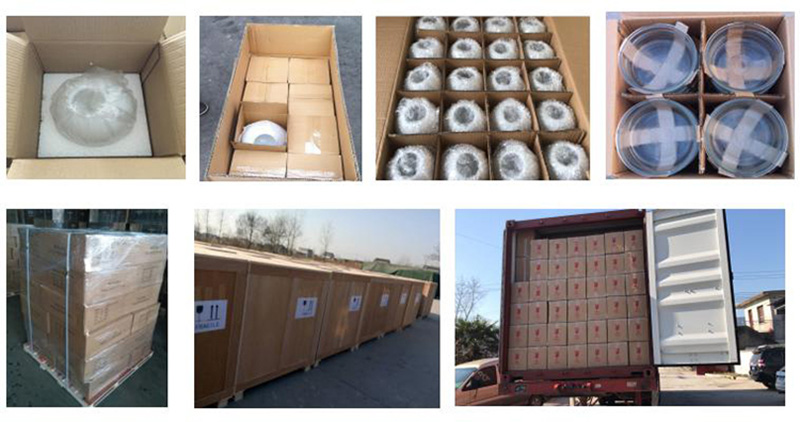
Packaging is part of the specification. Ask for the layer-by-layer packing method and pre-shipment photographs before the container is sealed. Image: Jingxin Glassware.
6. Write Acceptance Criteria Into the Purchase Terms
Define accept and reject criteria in the purchase order: opening diameter tolerance, wall thickness range, visual defects such as bubbles, scratches, cracks and deformation, opal or frosted uniformity, thread fit, and packaging condition. State the inspection level and the remedy for a non-conforming lot. Jingxin's standard process is 100 percent pre-shipment inspection for visual and dimensional defects, with third-party inspection available on request. That is the baseline to write into the contract, not a substitute for the buyer's own acceptance clause.
An acceptance clause without a measurement method is not enforceable. Specify the gauge, the light source, the viewing distance, and the sampling plan alongside the defect list.
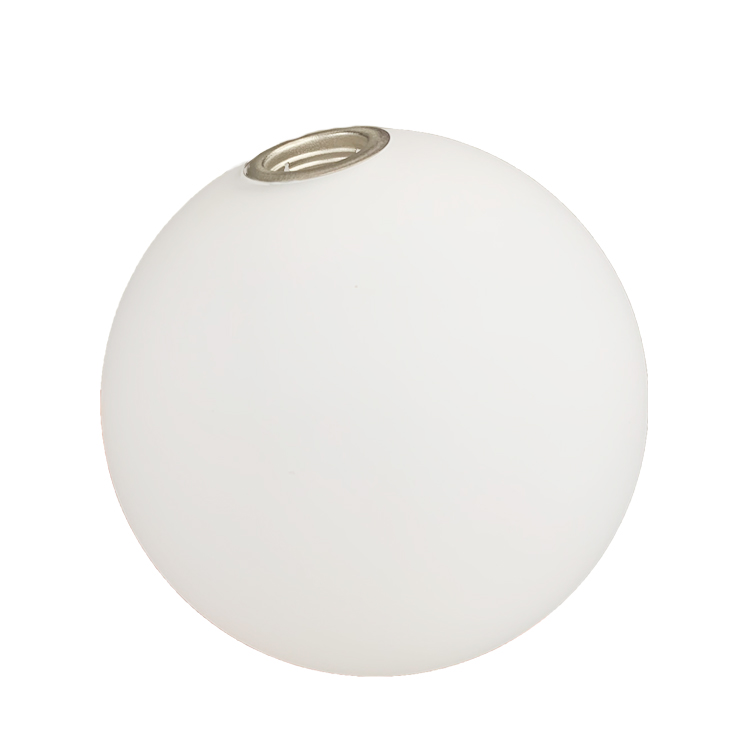
Fitter verification: the threaded opening is measured with a gauge, not judged by hand. Image: Jingxin Glassware.
Step-by-Step Supplier Evaluation Workflow
- Write a one-page specification sheet. Include glass type, shade diameter, opening diameter, thread type, wall thickness, surface finish, light transmission target, thermal range, packing method, and label requirements. A supplier cannot be held to a specification that was never written.
- Request written evidence for each parameter. Material declaration, thermal rating, thread drawing, and packaging specification. Mark any parameter that is answered with an adjective rather than a value.
- Order samples and measure them. Confirm the opening with a pin gauge, check wall thickness at four points, confirm whether the insert is metal or glass, and compare two samples under the same lamp for colour and diffusion.
- Verify certification and report traceability. Request the certificate number, the product scope, and the report date, and confirm that the report will be traceable to the shipment batch.
- Sign off the sample and the packaging together. Approve the sample only with the packing method that will be used in mass production. A sample approved without its packaging is only half approved.
- Define the inspection level before the first bulk run. Agree on 100 percent inspection or an agreed sampling plan, the defect classification, and the disposition of a failed lot.
- Confirm the timeline and the responsibility split. Jingxin publishes a sample lead time of 5 to 7 days and a mass production lead time of 20 to 30 days after sample approval. Agree who books freight, who owns the export documents, and what the inspection window is before shipment.
Use Cases: Where These Checks Change the Outcome
Hospitality and Retail Lighting Projects
In hospitality and retail lighting, consistency is the main failure point, because a single warm or dull shade is visible across a ceiling. Through-body opal diffusion prevents the drift that surface frosting can develop with cleaning. Jingxin supplied hand-blown opal white glass globe shades for a project with a French client for Galeries Lafayette in Paris in 2015, where the shades were installed as permanent wall decorations and remain in service. The relevant evaluation lesson is not the project name; it is that the specification asked for consistent opal colour and dimensional accuracy across a large installed set.
Compact G9 Fixtures
For compact G9 fixtures, the tolerance window is narrow. The JX1416 uses a 1.5 to 2 mm wall and a 22 mm threaded opening. The JX1184 uses a 2.5 to 3.5 mm wall and a built-in 20 mm metal insert. Choosing the wrong one shows up as a shade that sits loose, will not seat fully, or cracks at the mouth during installation. This is why the fitter drawing, not the product photo, should drive the selection.
High-Heat and Industrial Lighting
For high-heat installations, specify glass by temperature, not by price. The JX1830 borosilicate shade is published with a -40 to 260 degrees Celsius range, an IK10 impact rating, and a 6.0 to 10.0 mm wall thickness, and it is intended for petroleum, chemical, mining, marine and other hazardous-area fixtures. A soda-lime shade in the same fixture may pass the first inspection and fail in service.
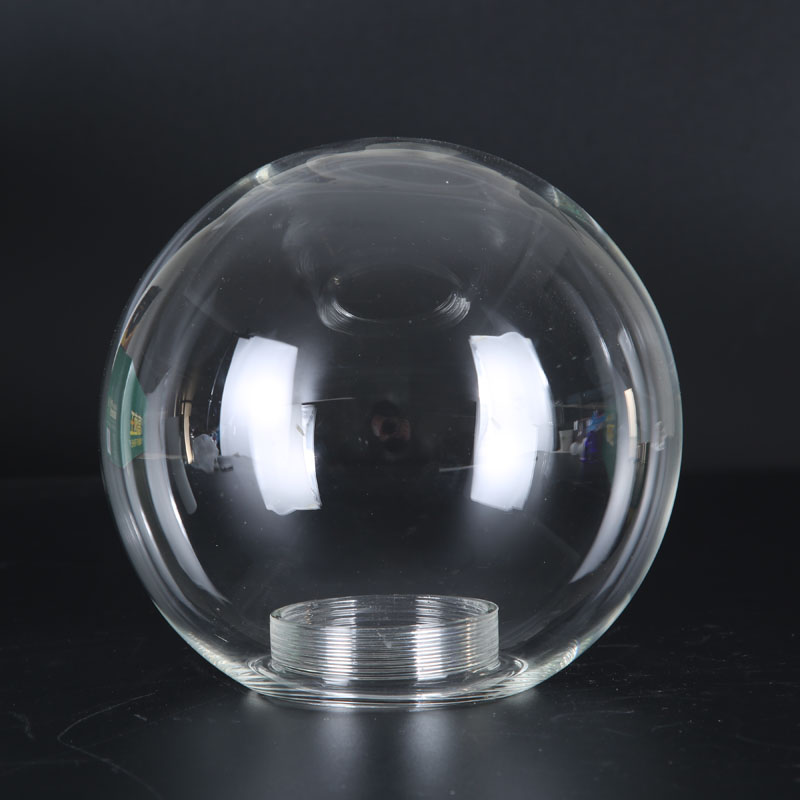
Borosilicate globes are specified by tested thermal range, not by the phrase 'heat resistant'. Image: Jingxin Glassware.
Comparison Table: Soda-Lime and Borosilicate Lamp Shades Under the Same Evaluation
| Evaluation dimension | Soda-lime opal shade (JX1184 reference) | Borosilicate shade (JX1416 reference) |
|---|---|---|
| Glass body | Solid opal white soda-lime glass | Borosilicate glass |
| Fitter | Built-in G9 metal internal thread insert, 20 mm opening | G9 thread, 22 mm threaded opening |
| Wall thickness | 2.5 to 3.5 mm | 1.5 to 2 mm |
| Light performance | 45 to 65 percent transmission, shiny white or frosted matte finish | 45 to 65 percent transmission, clear outer layer with frosted inner layer |
| Published thermal range | Up to 120 degrees Celsius | Up to 550 degrees Celsius |
| Sample lead time | 5 to 7 days | 5 to 7 days |
| Mass production lead time | 20 to 30 days after sample approval | 20 to 30 days after sample approval |
Note: the comparison uses published product data for two specific Jingxin models. Other models in the range use different fitters and wall thicknesses. Always evaluate the exact model against the fixture drawing and the measured shade temperature.
Frequently Asked Questions
1. Are Jingxin glass lamp shades CE, RoHS and REACH compliant?
Yes. Jingxin glass products are RoHS and REACH compliant, and the company holds 19 or more professional certifications including CE, RoHS, REACH, ISO 9001 and SMETA-4P. RoHS test reports are available on request. When evaluating any supplier, ask for the certificate number, the product scope it covers, and a statement that the report will be traceable to the shipment batch, rather than accepting a logo on a catalogue page.
2. Can a supplier hold G9 thread fit and thermal shock performance at the same time?
Both should be verified separately. G9 is a lamp holder family, not one dimension: the JX1184 uses a built-in G9 metal internal thread insert with a 20 mm opening and a 2.5 to 3.5 mm wall, while the JX1416 uses a 22 mm G9 threaded opening with a 1.5 to 2 mm wall in borosilicate glass. On thermal performance, the JX1184 soda-lime body is rated up to 120 degrees Celsius, the JX1416 borosilicate body up to 550 degrees Celsius, and the JX1830 borosilicate body from -40 to 260 degrees Celsius. Ask for the opening diameter, thread type, insert material, thermal range and test basis in writing.
3. What order quantity and cost drivers should a buyer expect?
Jingxin publishes a minimum order quantity of 500 pieces for select stock items, with custom MOQ negotiable. Cost is not driven by glass weight alone. The real drivers are the glass composition, the metal insert and thread specification, the surface finish such as frosted, acid-washed, painted or printed, the decoration complexity, and the packaging grade. Ask for tooling, sampling, inspection and packaging to be itemised separately so that quotes from different suppliers can be compared on the same basis.
4. Can samples be supplied before a bulk order?
Yes. Jingxin publishes a sample lead time of 5 to 7 days after specification and artwork confirmation, followed by mass production in 20 to 30 days after sample approval. When the sample arrives, measure the opening, check the wall thickness, confirm that the insert is metal rather than glass, compare two pieces under the same lamp for colour and diffusion, and confirm that the packing method shown with the sample is the one that will be used in bulk.
5. What is the typical production and delivery timeline?
Allow 5 to 7 days for samples and 20 to 30 days for mass production after sample approval, plus transport time. Confirm the mould status, sample approval date, inspection date and booking cut-off in writing before committing to an installation date. If you want to run this evaluation on a live project, send your lamp shade drawing and fixture specification to Jingxin Glassware at www.cn-glassware.com, by email at 3548596851@qq.com or 332138516@qq.com, or contact Mr. Jerry Zhou on +86 515-8822 9059 to arrange a sample and a quotation.
Conclusion
Supplier evaluation works best as a paper trail rather than an impression. The six checks - glass grade, diffusion method, fitter dimensions, thermal shock range, packaging specification and acceptance criteria - can each be verified in writing and each can be written into the purchase order. Together they answer the only question that matters at the evaluation stage: can this supplier repeat the approved sample across the run and deliver it intact.
Jingxin Glassware, formally Yancheng Jingxin Glassware Co., Ltd., has manufactured glass in Yancheng, Jiangsu Province since 1999. The company operates a 4,500 square metre production base with more than 100 employees, serves clients in more than 100 countries, and reports 19 or more certifications and 16 national patents. Its lamp shade range includes the JX1184 Blown Glass Lampshade with G9 Thread, the JX1416 Double Wall Glass G9 Light Globe, the JX1830 Explosion-Proof Borosilicate Glass Lamp Shade, the JX1407 Borosilicate Glass Globe Lamp Shade and the JX1004 Opal White Glass Globe Lamp Shade. Standard quality control includes 100 percent pre-shipment inspection, with third-party inspection available on request.
Next step: evaluate Jingxin against your own lamp shade drawing
Send your fixture drawing, target quantity and installation environment. Jingxin will confirm the suitable glass grade, fitter specification, thermal range and packing method, and arrange a sample for measurement.
Website: www.cn-glassware.com
Email: 3548596851@qq.com; 332138516@qq.com; 350879642@qq.com
Contact: Mr. Jerry Zhou, Tel +86 515-8822 9059
Download the glass lamp shade catalogue: Glass Lamp Shades Catalogue - Yancheng Jingxin Glassware Co., Ltd. (PDF)

Jingxin Glassware serves clients in more than 100 countries across lighting, home decor and laboratory glass categories. Image: Jingxin Glassware.
Have Questions or Need More Details?
Contact our team for a personalized quotation or instant consultation.
Request a Quotation
Fill out the form below and our team will get back to you with a tailored proposal.
WhatsApp Direct Chat
Prefer to chat in real-time? Message us on WhatsApp for instant assistance & quick answers.
- Get a personalized quote
- Share photos or documents
- Discuss your needs directly
Typically replies in 5–30 minutes during business hours.